Showing posts with label Ferrari. Show all posts

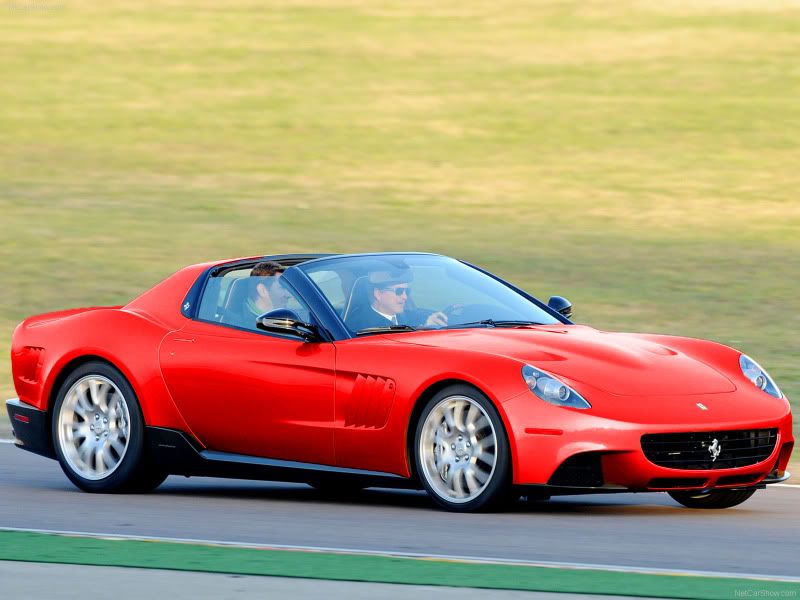
2010 Ferrari P540 Superfast Aperta

From the initial sketches to the final, road-legal car took just 14 months. As the 599 GTB Fiorano donor car is a coupé, considerable effort went into strengthening the chassis by using finite element analysis in development and the increase in weight was kept down to just 20 kg by employing carbon-fibre extensively. The car was designed by Pininfarina and built in Maranello, and the client was directly involved in each stage of its development.

2010 Ferrari P540 Superfast Aperta2010 Ferrari P540 Superfast Aperta
"I had always dreamed of designing sports cars," Walson explains, "and when I saw this film the decision came of its own accord: one day I would have 'my' Ferrari." In accordance with the Special Project's approach to producing such individual one-offs, the Ferrari P540 Superfast Aperta respects all existing international safety and homologation requirements and is thus road legal.

2010 Ferrari P540 Superfast Aperta2011 Ferrari P540 Superfast Aperta
2010 Ferrari P540 Superfast Aperta2010 Ferrari P540 Superfast Aperta

The Ferrari P540 Superfast Aperta's proud new owner, Edward Walson, son of John Walson, the inventor of cable TV, approached Ferrari in 2008 to produce a modern reinterpretation of the gold-coloured car in the film. The car, the second in a new Special Projects programme created by Ferrari to meet requests from the most discerning clients and collectors to create truly unique models, is based on the Ferrari 599 GTB Fiorano and was inspired by a Carrozzeria Fantuzzi-designed Ferrari built specifically for the 1968 Fellini film, Toby Dammit, itself inspired by one of the tales of Edgar Allan Poe.

2010 Ferrari P540 Superfast ApertaFerrari P540 Superfast Aperta

2011 Ferrari 458 Challenge

This mid-rear V8-engined berlinetta will allow Ferrari Challenge participants to enjoy to the full the exhilarating cut and thrust of With the new 458 Challenge, Ferrari is offering its sportier clients - professional and gentlemen drivers alike - a car that is extremely responsive, with great performance and superb handling. Equally impressive is the amount of lateral grip the new car generates - up to 1.6G. In the course of the intensive development sessions involved in honing the Ferrari 458 Challenge for the track, the engineers also managed to improve the car's lap time at Fiorano by two seconds over that of its predecessor, resulting in a new record of just 1'16.5".

2011 Ferrari 458 Challenge2011 Ferrari 458 Challenge
In high grip conditions it is also possible to select CT-OFF to de-activate the F1-Trac traction control. The driver can thus either chose from the WET or DRY configurations. The required ABS, F1-Trac and E-Diff calibration settings are selected via the manettino on the steering wheel, the first time this solution has been adopted on a model developed for the Ferrari Challenge series. The F1-Trac is completely integrated with the E-Diff to guarantee maximum acceleration out of corners. Two specific track-biased calibrations - wet and dry - have been developed for this application, with control logic and strategies derived from Ferrari's extensive racing experience in the F1 and GT championships.

2011 Ferrari 458 Challenge2011 Ferrari 458 Challenge

Ferrari 458 Challenge

Ferrari 458 ChallengeFerrari 458 Challenge

Ferrari 458 ChallengeFerrari 458 Challenge

Ferrari 458 Challenge

Ferrari 458 ChallengeFerrari 458 Challenge

The F1-Trac is completely integrated with the E-Diff to guarantee maximum acceleration out of corners. Two specific track-biased calibrations - wet and dry - have been developed for this application, with control logic and strategies derived from Ferrari's extensive racing experience in the F1 and GT championships. Developed in-house by Ferrari, the F1-Trac system constantly monitors levels of grip for maximum high-performance road-holding. Another first for a Ferrari Challenge model is the adoption of the F1-Trac traction control system, the most sophisticated of its kind.

It is also equipped with the new generation Brembo CCM2 brakes which debuted on the 599XX, Ferrari's extreme experimental laboratory car, and which are integrated with an ABS system that features two configurations - low grip and high performance for dry surfaces. The new Ferrari 458 Challenge also has a specific suspension set-up with solid aluminium bushings, stiffer springs, single-rate dampers, centre-nut 19" racing rims, larger dimension Pirelli slicks and a ride height lowered by 30mm all round.

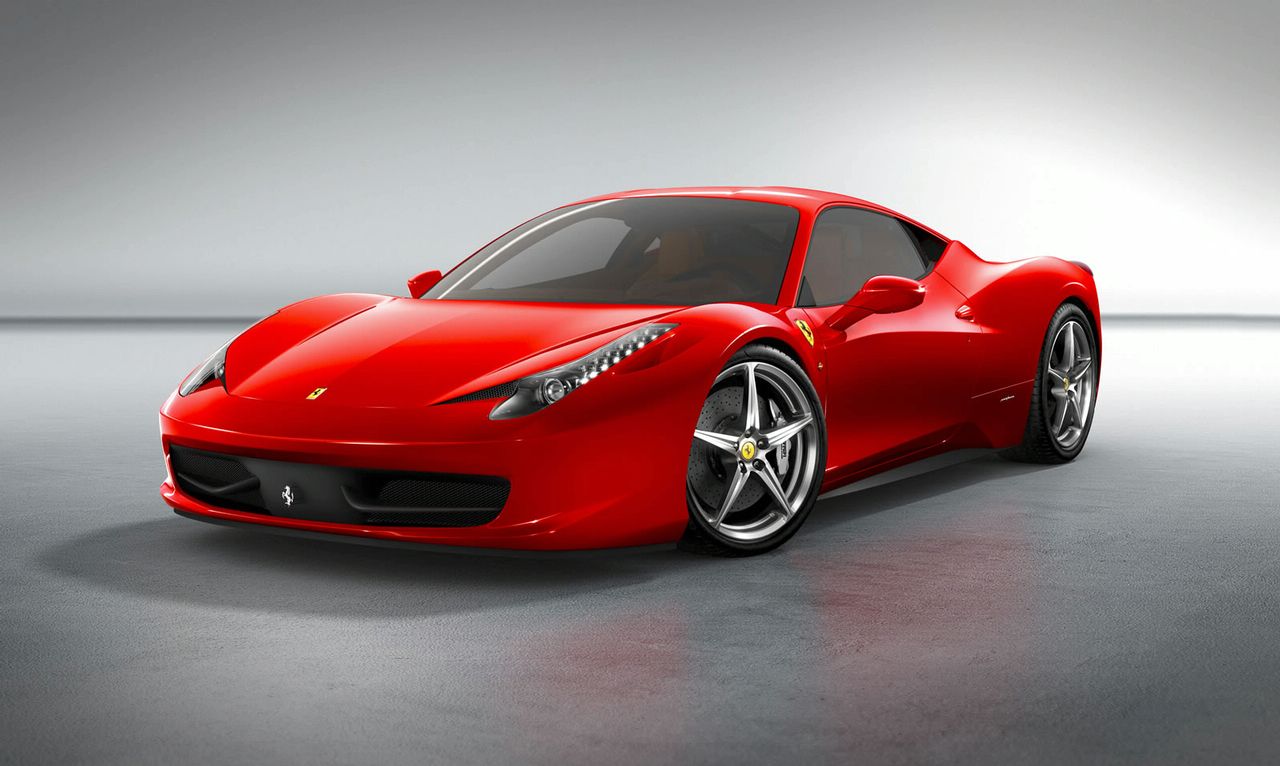
Ferrari 458 Italia

Ferrari 458 ItaliaFerrari 458 Italia

Ferrari 458 ItaliaFerrari 458 Italia

Ferrari 458 ItaliaFerrari 458 Italia

Ferrari 458 ItaliaFerrari 458 Italia
The engineers have developed specific, sportier gear ratios to match the power and torque curves of the new V8, guaranteeing high torque even at lower engine speeds and allowing the car to reach its maximum speed in top gear. The Ferrari 458 Italia is equipped with the seven-speed dual-clutch transmission which increases performance whilst providing very smooth shifts even at full throttle. The car's soundtrack is also typical Ferrari, with an exciting, powerful growl emerging from the engine before it channels through to the exhaust's three rear tailpipes. However, what is truly extraordinary is the amount of torque available while still maintaining high levels of power at low revs.

Specific torque is a record 120 Nm/litre. Maximum torque is 540 Nm at 6000 rpm, over 80 per cent of which is available from 3250 rpm. Equipped with the traditional flat-plane crankshaft, the engine delivers 570 CV at 9000 rpm and, with an outstanding power output of 127 CV/litre, sets a new benchmark not only for the whole Ferrari range and the history of company, but also for the entire market segment. It has a very low piston compression height typical of racing engines which contributed to achieving its compression ratio of 12.5:1.

Ferrari 599 GTO

Ferrari 599 GTOFerrari 599 GTO

Ferrari 599 GTOFerrari 599 GTO

Ferrari 599 GTOFerrari 599 GTO
The result is the almost complete absence of understeer and a truly communicative chassis. Fundamental to the GTO's performance is the innovative approach to chassis development which, for the first time on a production car, saw the integration between a handling set-up tuned for a level of responsiveness that is close to the limit and highly sophisticated electronic controls. Just as significant are the technical specifications - 670 hp in a 1495kg car represents a weight-to-power ratio of just 2.23 kg/hp, and ensures a 0-100 km/h acceleration time of just 3.35" as well as a top speed of over 335 km/h.

The Fiorano lap time provides just one indication of the potential of this car. The Ferrari 599 GTO benefits directly from the technological transfer from racing and set a record lap time at Fiorano in 1'24". The Ferrari 599 GTO is reserved for just 599 clients who seek the maximum expression of high-performance driving.

Ferrari 360 Modena

Ferrari 360 Modena
Ferrari 360 Modena
Ferrari 360 Modena

Ferrari 360 Modena was unveiled at the 1999 International Geneva Motor Show. Styled by Pininfarina, the all-aluminium 360 Modena has been designed to represent the ultimate in performance, lightness and advanced engineering and is the result of four years intensive research and design. This 'small' Ferrari incorporates superb handling due to a revised suspension system, excellent interior space with an exceptionally refined cabin layout. Powered by a normally aspirated, 400 hp, 3.6-litre, 40-valve, 8-cylinder engine the 360 Modena was available with the second generation of the highly successful F1-type gearbox as well as the conventional six-speed manual transmission.

This car had a significant part to play in the Ferrari model mix and will sit alongside the Ferrari 550 Maranello, the Ferrari 456M and the Ferrari F355 Spider. Offered as a two-seater sports car, the Ferrari 360 Modena replaced the highly successful and internationally acclaimed Ferrari F355. This addition to the Ferrari range was expected to account for 65% of Ferrari's annual production of around 3500 cars. The Ferrari 360 Modena initially went on sale in some of Ferrari's 42 key markets in Spring 1999. The car was available throughout the international Ferrari sales network by the Summer.

Ferrari 360 Challenge Stradale

Ferrari 360 Challenge Stradale
The all aluminium body and chassis are the ones designed and produced by Ferrari for the 360 Modena. The engine is the 3,586cc V8, with five valves per cylinder and titanium conrods, which secured a worldwide success for the Ferrari 360 Modena and the 360 Spider. The strong links of the Ferrari 360 Challenge Stradale road car to racing are underlined by a significant weight reduction, obtained also through a sporty set up and additional aerodynamic contents, enhanced braking performance and F1-style gearbox.

With the Ferrari 360 Challenge Stradale the racing expertise comes from the Ferrari Challenge International Championships and the FIA GT races, where the Ferrari 360 Challenge and 360 GT models are top protagonists, both in Europe and in the United States. The Ferrari 360 Challenge Stradale derives from the latest interpretation of the pure Ferrari tradition of making road cars directly derived from the race cars. It joined the Ferrari 360 Modena and the Ferrari 360 Spider in the Ferrari 8 cylinder range of road cars. The Ferrari 360 Challenge Stradale was unveiled at the 2003 Geneva Motorshow.

Ferrari 599XX

Ferrari 599XX
Ferrari 599XX
Ferrari 599XX
The Ferrari 599XX is characterised by an innovative electronic concept called the "High Performance Dynamic Concept" which has been designed to get the maximum performance from the car by managing the combination of the car's mechanical limits with the potential of its electronic controls. The mechanical and electronic systems work together to get the maximum performance from the car under extreme high performance driving, for consistent lap times. The sporty handling has been improved thanks to the adoption of second generation SCM suspension system. Track usage is also made easier thanks to the new "virtual car engineer", a screen in the car that provides a real-time indication of the vehicle's efficiency.